At its heart, semantic SEO is all about writing for humans first and search engines second. Instead of obsessing over individual keywords, this strategy focuses on building content around topics and the real meaning behind a person’s search. It’s a way of signaling to search engines that you understand the context and intent of a query, which in turn helps you rank for a whole constellation of related searches. For example, instead of just ranking for “running shoe,” you start ranking for “best running shoe for flat feet,” “how to choose marathon shoes,” and “lightweight daily trainer,” all because Google understands your content comprehensively covers the topic of running shoes.
From Keywords To Concepts: The Evolution Of Search
Think back to the early days of the internet. SEO was a pretty simple, if clunky, game. If you wanted to rank for “Missoula roofing contractor,” you just crammed that exact phrase onto your page as many times as possible. Search engines acted like a librarian who could only find books by their exact title, with no real understanding of what was inside. The result was often a page that read like a broken record, stuffed with keywords but offering little real value to the reader.
This keyword-stuffing approach created a web full of terrible, unhelpful content. It was a bad experience for users, and search engines knew they had to get much, much smarter. So, they started building algorithms that could understand language the way a person does.
The Rise Of AI In Search
The real game-changer was the introduction of sophisticated AI into search algorithms. Suddenly, search engines could see the connections between words, ideas, and real-world entities. It was a massive leap forward, driven by a series of landmark updates.
It all started to click with Google’s Hummingbird update back in 2013, which began prioritizing the context of a search. Then came the BERT update in 2019, which gave Google an incredible ability to understand natural, conversational language. This shift is clear in the data: by 2023, Google’s Knowledge Graph had ballooned to over 800 billion facts and 8 billion entities—a staggering jump from just 570 million entities a decade earlier. This means Google no longer just matches keywords; it understands the relationship between “Tom Brady,” “New England Patriots,” “quarterback,” and “Super Bowl” as interconnected concepts.
At its core, semantic SEO is about moving from a keyword-first mindset to a topic-first strategy. It’s about demonstrating comprehensive expertise that fully satisfies a searcher’s underlying need.
Why This Matters For Your Business
This isn’t just a technical tweak; it’s a fundamental change in how marketing works online. Today’s search engines, especially with their new AI-powered answers, are built to reward content that is deep, authoritative, and rich with context. Put simply, they want to send users to websites that are genuine experts on a subject.
This is why understanding semantic SEO is no longer just an advantage—it’s essential for survival. It’s the bedrock of sustainable online visibility. For any business that wants to grow, adapting to this topic-focused approach is the only way to genuinely connect with customers and build lasting authority.
It’s also the crucial first step before tackling more advanced concepts, like those we cover in our guide to Generative Engine Optimization. The goal has shifted. It’s not about ranking for a single keyword anymore; it’s about becoming the definitive answer for an entire topic.
The Three Pillars of a Strong Semantic Strategy
If you want to shift from the old, clunky world of keyword stuffing to a modern semantic SEO strategy that actually works, you have to get the fundamentals right. This isn’t about memorizing complex algorithms. It’s about focusing on three core pillars that perfectly mirror how people—and therefore, search engines—understand information.
Getting a handle on Entities, Context, and Intent is the secret to creating content that both your audience and Google will love.
Think of it like building a case for a client. You don’t just throw a bunch of random facts at the judge. You establish who the key players are (entities), you lay out the surrounding circumstances (context), and you directly address the core questions the judge needs answered (intent). A solid semantic strategy does the exact same thing for your content.
Pillar 1: Entities—The “Who” and “What”
First up, we have Entities. Forget keywords for a moment. An entity is any real-world object, concept, or thing that a search engine can definitively identify and connect to other information. It’s the difference between a simple string of letters and a recognized concept.
An entity can be a:
- Person (like Ruth Bader Ginsburg or Elon Musk)
- Place (like Missoula, Montana, or the White House)
- Organization (like Apple Inc. or The American Medical Association)
- Product (like the iPhone 15 or a Ford F-150)
- Concept (like Due Process or Photosynthesis)
When Google sees the word “Apple,” it doesn’t just see a word. It recognizes the entity of the massive tech company and instantly connects it to related entities like “Steve Jobs,” “iPhone,” and “Cupertino.” When you clearly reference these known entities in your content, you’re giving search engines solid, factual anchors that prove you know what you’re talking about. For example, an article about the history of Apple that mentions Steve Wozniak, the Apple II, and its headquarters in Cupertino is semantically richer than one that just repeats “Apple.”
Pillar 2: Context—Connecting the Dots
Next is Context. If entities are the nouns in your content, context is the web of meaning that surrounds them. It’s all the surrounding information that clears up ambiguity and shows how different concepts relate to one another.
For example, a page that just says “jaguar” over and over could be about the animal, the car brand, or even the NFL team. Context is what tells Google which one you mean. If your page also mentions entities like “big cat,” “rainforest,” and “endangered species,” the context is clearly zoological. If it includes “luxury vehicle,” “sedan,” and “dealership,” the context is automotive.
A single piece of content rarely provides enough context on its own. True topical authority is built by creating a network of interconnected pages—like a pillar page supported by cluster content—that collectively paint a comprehensive picture for search engines.
This is exactly why creating isolated blog posts is a failing strategy. By building out clusters of related articles and linking them together, you create a powerful web of context that demonstrates deep expertise on a topic. You’re no longer just a source; you’re an authority.
Pillar 3: Intent—The “Why” Behind the Search
Finally, and most importantly, we have Intent. This pillar is all about understanding the “why” behind someone’s search query. It’s not enough to match the words they typed; you have to solve the problem that made them search in the first place.
Search intent typically falls into a few main buckets:
- Informational: The user needs an answer or explanation. (e.g., “what are the symptoms of strep throat” or “how to change a tire”)
- Navigational: The user is trying to get to a specific site. (e.g., “Oaklea Media Solutions login” or “YouTube”)
- Transactional: The user is ready to buy something. (e.g., “buy work boots near me” or “cheap flights to denver”)
- Commercial Investigation: The user is weighing their options before a purchase. (e.g., “best personal injury lawyer in Montana” or “reviews of the new iphone”)
Aligning your content with the user’s intent is absolutely critical. You wouldn’t send someone looking to buy a product to a long-form history of your company. Mismatching intent is one of the fastest ways to tell Google your page isn’t the right answer, causing your rankings to tank.
The rise of AI-powered search has only made these pillars more essential. By 2025, AI vectors—which are basically numerical fingerprints for words and concepts—have become central to how search engines understand content. These vectors allow AI models to analyze meaning on a much deeper level, helping them cluster related content and recognize true topical authority. A firm grasp of entities, context, and intent is no longer optional for modern SEO. You can find more insights on these AI-driven optimization strategies at BigDog ICT.
Building Topical Authority With Topic Clusters
Alright, you’ve got a handle on the core concepts of semantic SEO—entities, context, and intent. Now, let’s talk about putting that knowledge to work on your website. The single most effective way to do this is by structuring your content using the topic cluster model. Think of it as the practical blueprint for proving your expertise to search engines.
It’s a bit like writing the definitive book on a subject. A single, random chapter might be helpful, but a complete book with a detailed table of contents and interconnected chapters? That’s authoritative. Topic clusters apply this exact same logic to your website’s content.
What Are Pillar Pages and Cluster Content?
The topic cluster model is built on two simple but powerful components: a pillar page and its supporting cluster content.
The pillar page is your “main chapter” or your cornerstone. It covers a broad topic from a high level, acting as a comprehensive resource that touches on all the key aspects of that subject. For example, a pillar page might be titled “A Complete Guide to Digital Photography.”
Cluster content, on the other hand, makes up the individual sub-chapters. Each piece of cluster content is a separate article or page that takes a deep dive into one specific subtopic mentioned on the pillar page. These articles are incredibly focused, giving the detailed, specific answers that people are often searching for.
For instance, a law firm might create a pillar page on “Personal Injury Law in Montana.” This page gives the big picture. The supporting cluster articles would then dig into the nitty-gritty, with topics like:
- “Statute of Limitations for Car Accidents in Montana”
- “What Counts as Negligence in a Slip and Fall Case”
- “How to Calculate Damages for a Personal Injury Claim”
The Power of Strategic Internal Linking
Here’s where the magic really happens: the internal linking structure. Your pillar page must link out to every single piece of its cluster content. Just as importantly, every cluster page has to link back to the central pillar page.
This creates a powerful, self-reinforcing loop of authority.
This deliberate linking architecture does a lot more than just help visitors navigate your site. It sends an unmistakable signal to search engines that your pillar page is the central hub of authority on the topic, and the cluster pages provide the depth and evidence to back up that claim.
The diagram below shows how a solid semantic strategy—driven by entities, context, and user intent—is the foundation for building this kind of authority.
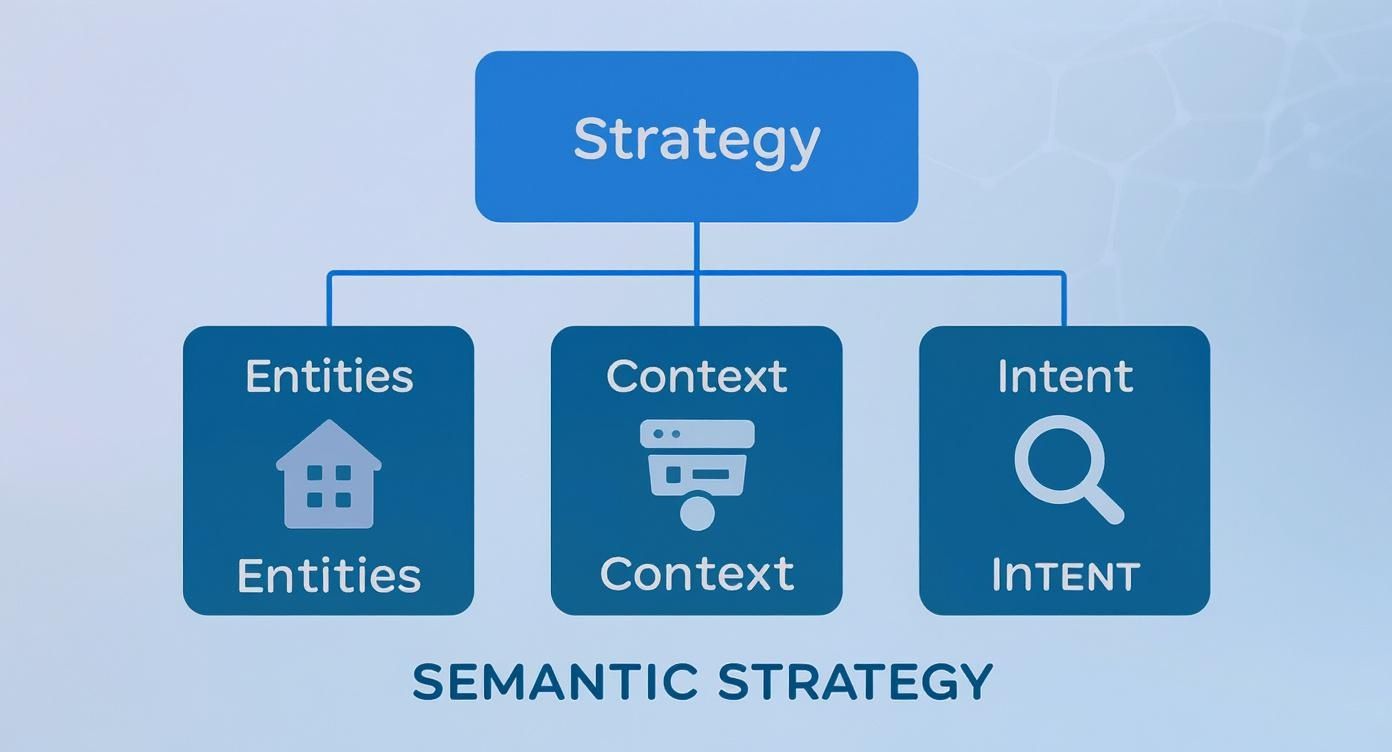
As you can see, a winning strategy isn’t about mastering just one element. It’s about how entities, context, and intent all work together to send a unified, powerful message to search engines.
How to Build Your First Topic Cluster
Ready to build one? The process is refreshingly straightforward. It all starts by figuring out what core subjects your audience truly cares about and then building out from there.
- Choose Your Pillar Topic: Start by identifying a broad topic that’s central to your business and has real search interest. It needs to be big enough that you can easily break it down into at least 5-10 solid subtopics. For a coffee roaster, this might be “Home Brewing Methods.”
- Brainstorm Cluster Subtopics: Dig into long-tail keywords, check out the “People Also Ask” boxes in Google, and see what your competitors are writing about. This research will reveal the specific questions and subtopics that will become your cluster articles. For the coffee roaster, this could be “How to Use a French Press,” “Pour-Over vs. Drip Coffee,” and “Best Coffee Grinders for Espresso.”
- Create Your Content: Write your pillar page first, making it a comprehensive guide. Then, create detailed, expert-level articles for each of your cluster subtopics. For more advanced insights to sharpen your content, take a look at our Semantic Knowledge Pack.
- Implement Internal Links: Once everything is published, it’s time to connect the dots. Meticulously add your internal links. Link from the pillar page out to each cluster page using descriptive anchor text, and double-check that every cluster page links back home to the pillar.
By following this model, you’re no longer just publishing random acts of content. You’re building a strategic, interconnected library of information. This structured approach is what semantic SEO is all about—it demonstrates expertise, satisfies user intent, and builds the kind of topical authority that today’s AI-driven search engines are built to reward.
Using Structured Data To Speak Google’s Language

If topic clusters give search engines the “big picture” of your expertise, think of structured data as the fine print—the critical, line-by-line details that fill in all the gaps. It’s a special vocabulary, also known as Schema markup, that you add to your website’s code.
This code doesn’t change what your visitors see on the front end. But on the back end, it explicitly tells search engines what every piece of your content actually is.
Imagine your law firm’s contact page. Without structured data, Google’s crawlers see a jumble of text and have to guess that “Jane Doe” is a person (a lawyer), “Missoula” is a city, and “555-123-4567” is a phone number. With structured data, you’re basically tapping the search engine on the shoulder and saying, “Hey, just so you know, this is a lawyer’s name, this is our business address, and this is our phone number.” For example, you’d use LegalService schema to define the business, Person schema for the lawyer, and PostalAddress for the location.
This removes all the guesswork. It lets search engines instantly understand and categorize your content with total accuracy, which is the entire point of semantic SEO—making meaning crystal clear.
From Simple Code to Rich Results
The real magic of structured data isn’t just about organizing information behind the scenes; it’s about what Google does with it. When search engines understand your content this deeply, they can upgrade your standard blue link in the search results into an eye-catching rich snippet.
You see these all the time. They’re the search results that pop with extra, helpful information, making them far more tempting to click.
Rich snippets powered by structured data often include:
- Star Ratings: That average review score sitting right under a product or local service.
- FAQ Dropdowns: Clickable questions and answers pulled directly from your page.
- Event Information: Key details like dates, times, and venues for upcoming events.
- Recipe Details: Cooking time, calorie counts, and a mouth-watering photo of the dish.
These enhanced listings do more than just look pretty. They deliver instant value to the searcher, which can seriously boost your click-through rate and hand you a major advantage over the competition. And the best part? Many modern website tools and plugins make adding this markup surprisingly straightforward. If you’re ready to dive deeper, you can learn exactly how to use Schema for AI-driven search optimization in our dedicated guide.
The Measurable Impact of Speaking Google’s Language
Adding structured data isn’t just a “nice-to-have” technical task; it delivers real-world results that you can actually measure. It’s a core part of helping search engines connect the dots, which is what semantic SEO is all about.
The results speak for themselves. In a 2024 case study, a design-focused website that fully embraced structured data and semantic strategies saw a 12% increase in new users and an 18% jump in organic traffic—all within just three months. The key was shifting from chasing algorithms to focusing on meaning, context, and relevance.
By providing clear, structured context, you not only improve your chances of earning rich snippets but also help secure your business’s information in Google’s Knowledge Panel, further cementing your entity’s authority.
Ultimately, structured data is your direct line to Google. It transforms your website from a simple collection of pages into a well-organized, machine-readable database. In an AI-first search world where understanding entities and context is everything, that kind of clarity isn’t just an advantage—it’s essential.
Putting Semantic SEO Into Practice With Real Examples
Understanding the theory behind entities, topic clusters, and structured data is one thing. Watching it all click into place with real-world results is another. Semantic SEO isn’t just some abstract concept for developers; it’s a practical game plan you can adapt for any business, whether you’re a national brand or a local roofer in Missoula.
So let’s get our hands dirty and move from theory to action. We’ll break down how different businesses can put a semantic strategy to work to better match what users are looking for, build genuine authority, and actually grow their bottom line. The core principles are always the same, but how you execute them will look a little different depending on your industry.
Example 1: The E-commerce Store
Let’s say you run an online store that sells high-end running shoes. For years, your strategy was probably to jam a single product page for the “NovaBlast Pro” with the keyword “best running shoes.” But that’s like trying to win a shouting match against Amazon and Runner’s World—it’s a losing battle.
A semantic approach is a whole lot smarter.
Instead of fighting that impossible fight, you build out a topic cluster around your star product. The product page for the “NovaBlast Pro” is your central hub, your pillar page. From there, you build out a series of helpful articles—your cluster content—that answer all the questions people have before they’re ready to buy.
Your content cluster could look something like this:
- A deep-dive review: “NovaBlast Pro Review: Is It Worth the Hype?”
- A head-to-head comparison: “NovaBlast Pro vs. CloudSurfer 7: Which Shoe is Right for You?”
- A problem-solving guide: “The Best Running Shoes for Overpronation” (where you naturally feature the NovaBlast Pro as a fantastic solution).
- An educational piece: “How to Choose the Right Running Shoe Cushioning.”
Every one of these articles links back to your main “NovaBlast Pro” product page. This strategy signals to Google that you aren’t just a seller; you’re a comprehensive authority on running shoe technology. Pretty soon, you’re not just competing for one impossible keyword. You’re ranking for dozens of long-tail search terms that attract real buyers at every single stage of their journey.
Example 2: The SaaS Company
Now, picture a SaaS company with a great project management tool. One of its standout features is an automated workflow builder. The old-school approach would be to create a generic landing page for “project management software” and call it a day. A semantic strategy, however, goes much deeper by proving expertise around the problems that feature actually solves.
The main feature page, “Automated Workflow Builder,” serves as the pillar. It gives the 30,000-foot view of the benefits and what the tool can do.
The cluster content is where the magic happens. It targets the very specific pain points of different customer types. This might be a mix of articles, guides, and case studies, each speaking to a different entity or use case:
- For Marketing Teams: “How to Automate Your Entire Content Approval Process”
- For HR Departments: “Streamlining New Employee Onboarding with Automated Workflows”
- For Digital Agencies: “A Practical Guide to Managing Client Projects Without the Chaos”
By creating content that speaks directly to specific jobs and industries, the SaaS company aligns perfectly with what we call commercial investigation intent. They aren’t just selling a feature; they’re showing exactly how it fixes a real, tangible business problem for a specific audience.
This builds powerful context around their product. More importantly, it brings in highly qualified leads who are already looking for a solution to the exact problem their software was built to fix.
Example 3: The Local Service Business
Finally, let’s bring it home with a local roofer in Montana. For any local business, semantic SEO is all about blending topical relevance with geographic signals. Your goal isn’t just to be seen as a roofing expert, but to be known as the best roofing expert in your specific service area.
The roofer’s homepage and core service pages (“Roof Repair,” “Roof Replacement,” etc.) act as the pillars. But the real power comes from weaving semantic keywords together with local entities and the right structured data.
Here’s what that looks like in practice:
- Create location-specific content: This means writing blog posts like “Common Causes of Roof Leaks in Missoula’s Climate” or “Choosing the Best Roofing Materials for Harsh Montana Winters.” This ties their expertise directly to local concerns.
- Use semantic local keywords: Instead of just “roofer,” they target phrases that show clear local intent, like “emergency roof tarping near me” or “hail damage repair in the Bitterroot Valley.”
- Implement
LocalBusinessSchema: This is huge. By adding this structured data to their website, they explicitly tell Google their business name, address, phone number, and service area. This markup is absolutely critical for showing up in the Google Map Pack.
This three-pronged attack—relevant content, local keywords, and technical signals—sends an unmistakable message to Google: this business is a legitimate, authoritative expert that serves this specific community.
Measuring The Success Of Your Semantic SEO Efforts
So, you’ve built out these amazing topic clusters and focused on user intent. How do you actually know if it’s working? The old way—obsessing over where you rank for one specific keyword—just doesn’t cut it anymore. That’s a relic of the past.
To really see the impact of semantic SEO, you need to think bigger. We’re moving away from narrow, vanity metrics and towards a set of indicators that show you’re actually building authority and attracting the right kind of traffic. It’s about measuring your overall footprint in a subject area, not just your position for a single term.
Moving Beyond Simple Keyword Rankings
The biggest mental shift is learning to track Topic Visibility. This isn’t about one keyword; it’s about how many different—but related—search queries your entire topic cluster shows up for. When your semantic strategy hits its stride, your main pillar page and all its supporting articles will start ranking for hundreds of long-tail questions and search variations.
Think about it this way: a law firm’s cluster on “Personal Injury Law” isn’t truly successful just because it ranks for that main phrase. Real success is when it also starts appearing for searches like “how long after a car accident can you claim injury?” or “what is considered negligence in a slip and fall?” That broad visibility is the clearest sign you’ve built genuine topical authority.
Tracking What Really Matters
Getting a complete picture of your performance means looking at a mix of metrics that show both visibility and, just as importantly, user engagement.
Here’s a look at the modern way to measure your semantic SEO effectiveness, moving beyond the simple metrics of the past.
| Metric | What It Measures | How To Track It |
|---|---|---|
| Topic Visibility | The total number of relevant keywords and long-tail queries a content cluster ranks for. | Use an SEO tool like Ahrefs or Semrush to monitor keyword growth for a specific URL group or folder. |
| Rich Snippet Performance | How effectively your structured data is capturing attention and clicks in the search results. | Track impressions and clicks for pages with rich results (FAQs, How-tos, etc.) in your Google Search Console performance report. |
| Organic Traffic to Clusters | The growth in qualified organic traffic to a specific group of related pages, not just the whole site. | Set up content groupings in Google Analytics 4 to isolate and track traffic trends for each topic cluster. |
| User Engagement Signals | How well your content satisfies user intent once they land on your page. | Monitor time on page, scroll depth, and a low bounce rate in your analytics platform. High engagement is a powerful signal to Google. |
Ultimately, these KPIs give you a much more honest and accurate view of your SEO health. Instead of chasing a single ranking, you’re tracking the growth of your authority, which is what drives sustainable, long-term results.
Frequently Asked Questions About Semantic SEO
Even with a good grasp of the basics, a few questions always seem to come up when people start digging into semantic SEO. Let’s clear the air on some of the most common ones so you can move forward with confidence.
Are Keywords Still Important in Semantic SEO?
Yes, absolutely. But how we use them has completely changed. The old game of repeating a primary keyword over and over is dead. Now, the goal is to weave in a rich tapestry of related terms, synonyms, and long-tail phrases that build deep contextual relevance.
Think of your main topic as the sun. A single keyword is just that one star. A semantic approach builds the entire solar system—the planets, moons, and asteroids—of related concepts orbiting it. This constellation of terms proves to search engines that you’re an actual expert, not just someone who knows how to repeat a word.
Is LSI the Same as Semantic SEO?
Not at all, and this is a really common point of confusion. Latent Semantic Indexing (LSI) was an older technology that simply looked for words that frequently appeared together in documents. It was a step up from basic keyword matching in its day, but it’s ancient history in internet years.
Semantic SEO is a different beast entirely. It’s powered by sophisticated AI, like Google’s Knowledge Graph, which understands the relationships between real-world things, not just words on a page. LSI saw statistical word associations; semantic SEO understands meaning and intent.
How Long Does It Take to See Results?
This isn’t an overnight fix. Semantic SEO is a long-term strategy focused on building genuine authority, and that takes patience. Generally, you can expect to see the first positive signs—like ranking for more long-tail, specific questions—within 3 to 6 months.
The more significant results, like major traffic growth and top rankings for your core topics, usually start kicking in after 6 to 12 months of consistent work. This timeline really depends on factors like how competitive your industry is, the state of your website today, and how consistently you’re publishing high-quality, optimized content.
Ready to build a content strategy that search engines and your future clients will love? At Oaklea Media Solutions LLC, we specialize in creating compliant, authority-building semantic SEO campaigns for law firms, medical practices, and local trades. Learn more about our approach and start your journey to lasting digital visibility at https://oakleamediasolutions.com.
Article created using Outrank